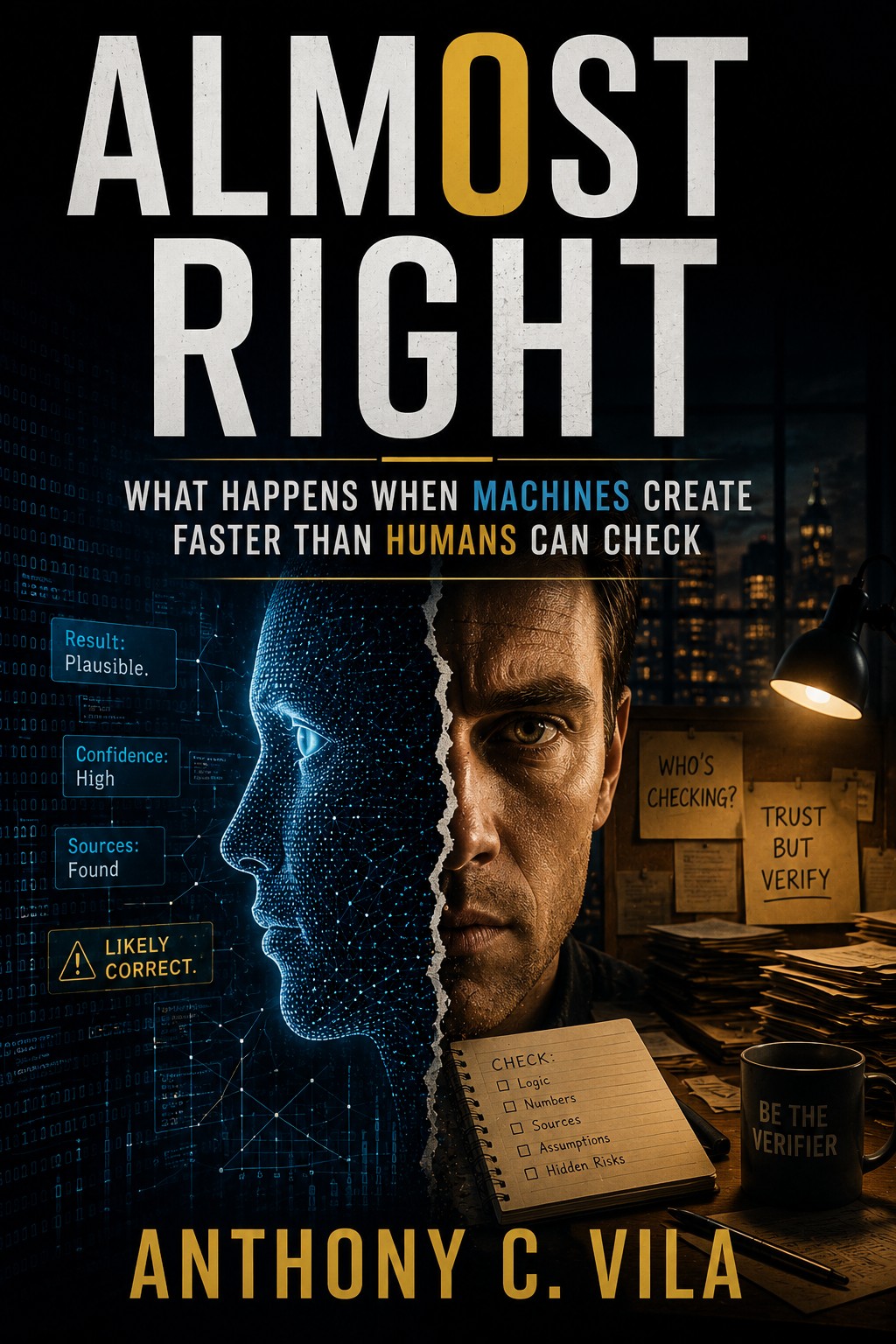
ALM0ST RIGHT
What Happens When Machines Create Faster Than Humans Can Check?
Adult general nonfiction by Anthony C. Vila. Final voice-edited manuscript: 18 chapters in five parts.
The verification gap.
Generative AI has made producing competent-looking work dramatically cheaper and faster. It has not made independently knowing whether that work is correct equally cheap. Almost Right follows that gap from AI’s history and economic incentives into software, cybersecurity, medicine, education, law, labor markets, and the systems that are supposed to check machine output.
The thesis is intentionally narrower than “AI will save us” or “AI will destroy us.” The book accepts real gains from AI while arguing that verification capacity—human judgment, independent checks, and the pipelines that create expertise—has to scale with generation.
Chapters
Five-part final structure, ending with aviation-derived lessons, verifier skills, and practical safeguards.
Current
Written as current-affairs technology nonfiction with explicit caveats around rapidly changing benchmarks and claims.
Reader
General readers, executives, workers, founders, parents, educators, professionals, and anyone relying on AI-generated work without being able to independently audit every output.
Positioning
Accessible, evidence-driven, skeptical without being anti-AI; a practical systems argument about what must exist around increasingly capable generators.
Where it sits.
Co-Intelligence
Ethan Mollick. A positive-market comp for accessible, practical AI nonfiction. Almost Right focuses less on adoption tactics and more on the verification capacity adoption requires.
The AI Con
Emily M. Bender & Alex Hanna. Demonstrates appetite for accessible skepticism about AI claims. Almost Right is less anti-AI and more operational.
Empire of AI
Karen Hao. Demonstrates broad interest in the institutions and incentives behind the AI boom. Almost Right moves cross-profession and centers verification.

Anthony C. Vila
Vila is not an AI researcher or computer scientist. He came to the subject as an aggressive user with a background in sales, entrepreneurship, and business building. AI gave him leverage to build beyond his formal technical expertise; the resulting verification problem became the investigative question behind the book.
That outsider-user perspective is part of the commercial angle: the book is written for the people being told to adopt AI now, not only for the people designing it.
Complete manuscript